
Blog

The World Is Getting Freer, Faster

According to the new Fraser Institute report, economic freedom is steadily increasing, and that’s a good thing.

Earlier today, the Fraser Institute published the 21st edition of its annual Economic Freedom of the World (EFW) report. The Canadian think-tank uses 42 data points across five different areas (size of government, legal/property rights, sound money, freedom to trade internationally and regulation) to rank the economic freedom of 159 countries and territories.

The results? As Johan Norberg puts it, “freedom is awesome”. Which is to say that – almost without exception – the freer the country, the more rapid its economic growth, and the higher its citizens’ income.

The full report is available on the Fraser Institute’s website. But here are the key points:

America is not the real Land of the Free

Hong Kong, despite recent political upheavals, takes the top spot – as it has since 1980. For the tenth year in a row, Singapore comes in second. New Zealand, Switzerland, Ireland, the UK, Mauritius, Georgia, Australia, and Estonia make up the rest of the top 10. The United States has moved up from 13th spot to 11th. There it joins Canada, which has fallen six places. Other notable rankings are Germany in 23rd place, France in 52nd, Mexico in 76th, Russia in 100th and China in 112th place.

The freer the country, the better

Why do the positions on the list matter? They matter because, as mentioned above, there is a high correlation between economic freedom and important indicators of human well-being.

The freer the nation, the better off the poorest people in it are.

The Fraser Institute splits the measured countries and territories into quartiles (i.e., each quartile represents a quarter of the samples) based on their level of economic freedom. The freest quartile has an average income that is seven times higher than that of the least free quartile ($42,463 and $6,036 respectively). Between 1990 and 2015, economic growth averaged 3.35 percent a year in the freest quartile, whereas the least free experienced a measly 1.66 percent growth.

It’s not just about money. In the freest nations, life expectancy is 80.7 years. This is 16.3 years more than in the bottom quartile. For many people, that amounts to a difference between knowing one’s grandchildren or dying before their birth.

Finally, the freer the nation, the better off the poorest people in it are. The bottom 10 percent of income earners in the freest quartile earned 11 times more than the bottom 10 percent in the least free quartile ($11,998 per year and $1,124 per year respectively). In the freest countries, the poorest 10 percent make almost twice as much as the average person in the least free countries.

Economic freedom isn’t just about the economy

The inclusion of the index acknowledges that women are not always accorded equal treatment before the law.

For the first time, the 2017 edition of the report has adjusted its methodology to include the Gender Disparity Index (GDI). The inclusion of the index acknowledges that women are not always accorded equal treatment before the law. By using information from the World Bank’s Women, Business and Law and 50 Years of Women’s Rights projects, the Fraser authors have amended the EFW scores retrospectively.

This methodological change has meant that the Arab nations have dropped – a lot. (The report was compiled before the news broke that Saudi women will now be allowed to drive, but I don’t think it would have affected the findings much.)

In the previous report, for example, there were four Middle Eastern nations within the top 30. Now that GDI is included, not a single Arab nation ranks in the top 36. The United Arab Emirates and Qatar, which were previously the highest ranked MENA nations at 5th and 11th places respectively, are now just 37th and 45th. And the 10 countries that experienced the biggest decreases due to the GDI adjustment were all Muslim-majority nations.

The world is getting freer, faster

Economic freedom has increased substantially in the last 25 years – especially in developing nations.

This is the final and most important point to make. Despite our tendency towards pessimism about the state of the world, economic freedom has increased substantially in the last 25 years – especially in developing nations.

In 1990, the average score for a “high-income industrial” country was 7.18, compared to only 5.28 for the average “developing” country. By 2015, the average score in high-income countries was 7.76 and the average in developing countries was 6.61. The gap between the two groupings has fallen from 1.90 to 1.15 – an improvement of 40 percent. This is thanks in large part to trade liberalization and the widespread conquest of inflation and introduction of sound money.

The result is that, if the 1980s world average was a nation, it would place in 154th place today – ranking between war-torn Syria and anarchic Libya. If the 2015 world average was a nation in 1980, it would be the 9th freest – with a score of 6.88, slightly above Canada at the time.

The new EFW shows that despite many anomalies and challenges, economic freedom remains deeply linked to important indicators of human well-being, including wealth, poverty alleviation and life expectancy. As such, it is the poorest members of the human family who get the greatest benefits from it. Long may that continue.

Reprinted from CapX

Read more

Nigerian Government Just Take a Remarkable Leap towards Free Market

Courtesy: Vanguard News Nigeria
 
The Federal Government has granted a 3-year tax relief to the newly inaugurated Pay TV operator in the country, TStv Africa, as well as tax free dividends to all investors in the company. Lai Mohammed The Minister of Information and Culture, Alhaji Lai Mohammed, announced this on Sunday night in Abuja at a dinner to mark the official unveiling of the new company.
 
TStv Africa is a wholly owned Nigerian Pay TV operator with refined offerings of novel Unclassified Pay Per View subscription and complimentary internet services. Mohammed, who performed the official unveiling of the new company and its products, said the tax reliefs were in line with the Pioneer Status recently granted to the Creative Industry by the federal government. The minister congratulated the Chief Executive Officer (CEO) of the company, Dr Bright Echefu, and his team for liberalising and breaking the monopoly of Pay TV in the country.
 
“The important thing about what Echefu has done today is that he has redefined the pay per view television industry and from today that industry will never remain the same again. “What he has done is to democratise the media and entertainment industry and make it possible for even a peasant farmer to have access to the best entertainment and news in the world.
 
“It is a great opportunity for me to be the one to unveil TStv because just like a Nigerian made history by crashing the cost of telephony in Nigeria, I am glad that another Nigerian is now coming forward to crash the cost of Pay TV,” he said. The minister commended the courage of the investor for coming from the Diaspora to invest in his country and for believing in the government’s seriousness about diversifying the economy.
 
He said the company had also demonstrated that government alone could not do all things but needed the participation and synergy of the private sector. “I want to assure that this administration will continue to assist you and other investors in creating the enabling environment for businesses to grow,” he said. The minister said that the government was aware of the huge contributions of the creative industry to the nation’s economy and would continue to support the sector.
 
However, he identified contents and the lack of objective audience measurement as major challenges that had retarded the growth of TV and advertising industries in the country. “With the liberalisation of the industry, content has become very key because content determines which channels are being watched and which are not. “Another major challenge is how to get an accurate measurement of which channel is being watched and which is not. “Kenya and South Africa are about one third of our population but they do much better in TV and radio advertisement than us because of their robust audience measurement,” he said.
 
The minister announced that the National Broadcasting Commission and his ministry would organise a workshop on Nov. 28 to address the challenge of audience measurement. Earlier, Echefu said that TStv Africa, which had gone through a lot of challenges, was birth to liberalise PayTV in the country, make it affordable to every Nigerian with added values. He said for the first time, Nigerians could now enjoy Pay Per View because with TStv, “subscription runs as you watch and it has the facility to pause your subscription when you travel”.
 
Echefu said that TStv for a start has 70 premium channels model with the cheapest pay-TV in Africa with maximum subscription fee of N3,000 only. He said as a fully Nigerian brand with consideration for the masses, TStv is not classified and it has a model that accommodate subscription as low as N200 as N500 for a period of time.
 
The CEO said TStv came with PVR (Personal Video Recorder) Decoder which allowed viewers greater control over their viewing experience with functions like pause, rewind, forward, save and record of programmes of interest. Echefu said that once you subscribe to TStv, you will also get complimentary internet service, enabled Wi-Fi, as well as video calls and video conferencing services.
 
“It has an array of amazing TV channels with premium entertainment, educative programmes that cut across all genres. “The genres included news, music, general entertainment, documentary, movies, religious, sports, health, kids, fashion and lifestyle that better define the uniqueness of Nigeria’s diverse culture and traditional values,” he said.
 
The CEO said TStv which was modelled for Nigerians had come to stay, assuring that it would not fail and they would deliver on their promises. The guests at the ceremony were entertained with live performances by musicians and comedians.
 
Among the dignitaries at the event were Gov. Akinwumi Ambode of Lagos represented by the Permanent Secretary, Lagos State Ministry of Information and Strategy, Mr Fola Adeyemi, and the Permanent Secretary, Federal Ministry of Information and Culture, MS Grace Gekpe. Others were the Director-General of National Orientation Agency, Dr Garba Abari; former Minister of Aviation, Femi Fani-Kayode; Nollywood actors including Emeka Ike. Adigwe Okafor, Zack Amata, Dr Opa Williams and Afeez Oyetoro aka Saka.
NAN
Read more

Everyone Loves This Book But Who Has Actually Read it?

After years of avoiding Hayek’s Road to Serfdom, I have decided to dedicate the next sixteen days to liveblogging each chapter.
 

I have never actually completed F.A. Hayek’s, The Road to Serfdom. I am completely comfortable admitting that. Still, like many who are intrigued with Hayek’s ideas but lack the willpower to read the entire book, I alway list The Road to Serfdom as one of my most influential readings.

To be sure, I had read the few chapters that were assigned to me by my school’s token libertarian political science professor. I assumed I had accurately interpreted its message. The three chapters I read were full of highlights and great quotes about the importance of the individual. But with all the other books out there in the world, why was finishing this one book so important?

Hayek makes it clear that this path refers to society’s “progressive” rejection of individualism.

It was not until my current mentor called me out on my inability to follow through on one of the most economically relevant books of all time, that I realized that I had robbed myself of an education by not finishing Hayek’s important work.

As a matter of millennial pride and also wanting to reclaim the knowledge I foolishly pushed aside as an undergrad student, I decided to dedicate the next sixteen days to both reading and liveblogging The Road to Serfdom.

The Individual Built the Modern World

Proponents of laissez faire capitalism and libertarian thinkers alike constantly throw around the phrase,” the road to serfdom.” And while most understand its general negativity towards socialism, the phrase is so ingrained in liberty speak that few often take the time to really explore what Hayek was trying to tell us.

In the book’s opening chapter, “The Abandoned Road,” Hayek makes it clear that this path refers to society’s “progressive” rejection of individualism. More importantly, he goes on to describe how this rejection of the sanctity of the individual has, and will continue to have, negative impacts on the society.

For a period of time, the western world had flourished under the 19th-century ideals of free market capitalism. For the first time in history, an individual was allowed to follow his own desired path without the status of his birth holding him back. All he needed was an idea and the ambition needed to make that idea a reality.

As a result we saw a revolution in thought and an industrial revolution incomparable to anything the world had ever experienced. In fact, even with the advent of the internet, the world has still never progressed quite as dramatically as it did during this laissez faire revolution.

And while this period brought the world the wisdom of Adam Smith and the rebellion of the American Revolution, it did not maintain its momentum of popularity as the 20th century approached.

As Hayek points out:

“We still believe that until quite recently we were governed by what are vaguely called nineteenth-century ideas or the principle of laissez faire…But although until 1931 England and America had followed only slowly on the path which others had led, even by then they had moved so far that only those whose memory goes back to the years before the last war know what a liberal world has been like.”

If in 1944, Hayek thought the world had already forsaken and forgotten true liberalism, I can scarcely imagine what he might say today. And it’s true that he was writing about a period of wartime economic planning both in the US and the UK. Prices and wages were controlled. Censorship was in place. Rationing and quotas governed the production and distribution of all essential goods and services. But even given all this, government consumed a far smaller degree of overall national production than today.

So far removed are we in 2017, that the individual is not even a consideration when contemplating economic policy. In fact, the “greedy” “selfish” individual is often the villain in modern economics, as he seems to always operate contrary to the whims of the collective. Now, terms like “individual mandates” are used to convey each person’s “social responsibility” to care for the collective.

As common as this anti-individualist sentiment has become, it wasn’t always this way. As Hayek reminds us in this opening chapter, the most tremendous strides towards human and economic progress were taken during a time when the individual was allowed to innovate and create without worrying about interference from the state on the grounds of protecting the greater good. But even though the positive implications of a pro-individualist society were proven by the innovations created during that time, society had still been steadily moving away from it.

“We are rapidly abandoning not the views merely of Cobden and Bright, of Adam Smith and Hume, or even of Locke and Milton, but one of salient characteristics of Western civilizations…Not merely the nineteenth- and eighteenth- century liberalism, but the basic individualism inherited by us from Erasmus and Montaigne, from Cicero and Tacitus, Pericles and Thucydides, is progressively relinquished.”

So far removed are we in 2017, that the individual is not even a consideration when contemplating economic policy.

Again, I have to wonder what Hayek might say if he were alive today and around to see how groupthink and collectivism have shaped our modern policies.

This chapter, then, sets the stage. He names liberalism as the system that gave birth to the greatest of human achievements ever seen in history. It was individualism that caused the most spectacular effect. If you understand that–and vast numbers today do not understand this–you are prepared to see how the abandonment of this system and idea leads to not only the unraveling of liberty but even what we call civilization.

So, yes, this book is a warning, not just against one party but all ideological positions that reject individualism for one or another version of the planning state.

Now onward to chapter two!

Read more

Finding alternative strategies in Nigeria’s war against corruption

By Doyin Olawaiye 

‘A rotten apple spoils the whole barrel’ is the proverbial saying that has been used by many to describe how corruption spreads. This suggests that a bad person can infect/corrupt a group of people. The story of Eve and the serpent in the Garden of Eden corroborates this notion. The serpent deceived on Eve, who went on to deceive Adam, and Adam in turn infected the entire world with sin, as the story goes. However, you are likely to read stories about rotten apples, not about rotten barrels. So what happens when the barrel is rotten? As corruption is both systemic and endemic in Nigeria, it begs the question: Is Nigeria a rotten barrel? In such a situation, where are the positive influences expected to come from? Can those who are themselves down help others up?  Can many wrongs make right?  What are the implications of tackling corruption in a rotten barrel?

According to the Organisation for Economic Co-operation and Development (OECD), corruption increases the cost of doing business; excludes the poor from public services; and, delegitimizes the State. Corruption also has adverse budgetary effects in that it leads to waste or the inefficient use of public resources. Imagine schools without chairs; hospitals without drugs; pensioners without pension; housing units without water; citizens without passports; Internally Displaced Persons (IDP) camps without food, and universities without research laboratories. Sadly, you do not have to imagine too hard. This is the reality that depicts the Nigerian State, which can be equated to the decay that occurs in a rotten barrel.

Corruption in Nigeria is pervasive and has untold consequences. The cost of corruption though topical and deserving of a lot of attention is not often discussed because it is hard to establish a direct causal link; there is a plethora of other factors that may be responsible for poor service delivery and underdevelopment in corruption-prone countries. Nevertheless, the high correlation between corruption and the pathetic state of our nation is not to be ignored.

Corruption is said to limit economic growth as it dissuades investment into the country. Researchers at the International Monetary Fund (IMF) claimed that countries, where corruption is rife, are likely to have 5 per cent less in investment than countries with lower corruption rates.  In addition, a PwC Nigeria report estimated the economic cost of corruption to be approx. $1,000 per person in 2014. The report warns that this could balloon to 37% of GDP by 2030 if corruption is not dealt with right away. This would translate to about $2,000 per person by 2030. How about the human cost of corruption? Can this cost be quantified? Perhaps a measure of corruption in body bags may drive home the point. How many people have died because there was a lack of oxygen in our hospitals? How many die from expired malaria drugs? How many fatal road traffic accidents are due to bad roads? How many deaths from severe burns owing to adulterated fuels? And the list goes on.

These figures and probable impacts are mind boggling and disturbing yet corruption continues to thrive in the land. Clearly, something is wrong! The anti-corruption strategies and tactics deployed by past and present administrations have been largely ineffective, as the focus has been on drawing attention to the bad apples only.  How then does one successfully fight corruption in a rotten barrel?

The rotten barrel notion suggests that corrupt tendencies in a person can be attributed to widespread societal influences and pressures. Citizens have been shaped by standards and customs in the society that permit dishonesty. This implies that the likelihood of being incorruptible in an environment predisposed to corruption is extremely low if not near impossible. Researchers at the University of Nottingham and Yale University found that corruption not only harms a nation’s prosperity but also shapes the moral behaviour of its citizens. The impact of corruption is more damaging when the barrel is rotten because people tend to acclimatise in the rot. Imagine stepping out of a crowded room for a while and stepping back into the room only to discover the air in the room is stale and pungent and has always been. Citizens are simply unable to link corruption to the state of their affairs, as they are also infected with the same virus. How else does one justify a corrupt politician being publicly celebrated in his constituency even though he steals from them? Or how a former Chairman of an agency charged with an anti-corruption mandate is being investigated for corruption? Ibrahim Lamorde, former Chairman of the Economic and Financial Crimes Commission (EFCC), was alleged to have fraudulently diverted over N1tn proceeds of looted funds recovered by the agency. It’s little wonder that with the recent discovery of over N13 billion in a Lagos apartment, citizens are being subjected to an episode of -Whose Money is it Anyway? Multiple interests continue to vie for ownership of the funds. Many Nigerians are now wondering whether this is a deliberate attempt to divert attention away from the money so that the real looters can get away with it.

Is the story all bleak then? Corruption is ultimately a learned behaviour and as such the fight against corruption, though multi-faceted, must be primarily focused on behavioural change strategies and interventions if it is to be sustained and effective. Nonetheless, how does one go about fixing the barrel? Is it about the apple(s) in the barrel or the barrel itself or both? Can one really be separated from the other or are both intertwined? Can a person really be separated from their culture? These are pertinent questions we must answer if we are to gain ground in the fight against corruption.

By focusing on behavioural change strategies and interventions, the fight against corruption will progressively be championed by all. Institutions, such as the home, religious institutions and schools, responsible for value reorientation and learning should be targeted. Places of learning should be specifically targeted as they are where an understanding of what corruption is in the Nigerian context and its associated risks and impacts should emanate from.  Being able to identify what corruption really is, the cost of corruption and how much of a corruption risk an individual or organisation is are good places to start.

Doyin Olawaiye is a Public Policy Manager at The Integrity Organisation, an anti-corruption training, research, advocacy and consulting organisation founded in 1995.

Reprinted from AfricanLiberty.org


Read more

The Real Reason Young People Can’t Get Jobs in Africa

Youth unemployment in Africa is sky-high, and that’s a serious problem.


6.8 percent: that was July’s seasonally adjusted unemployment rate for US workers ages 18–44. For those ages 18–24, the rate was 9.5 percent. That’s a high rate for young people. But if you were 20 years old and lived in Africa, you might be thrilled with an unemployment rate like that.

Today, 60% of all those unemployed in Africa are youth. In South Africa, more than 55% of young people are unemployed. Those are staggering figures. And many who are working are underemployed: with a job in the informal sector, working only a few hours, or helping on family farms or in family businesses. They scrape by as “necessitous” entrepreneurs doing what they can to survive, often juggling multiple informal jobs.

Given that Africa has the world’s youngest population, the lack of steady, formal-sector jobs is an enormous political and economic risk factor. Unemployed youth are more likely to be criminals, may be lured into militant groups, and contribute to political unrest. With few other opportunities, the cost of engaging in harmful behaviors is lower than it otherwise would be. Economic vulnerability among the young contributes in important ways to overall social instability that frustrates economic growth.

This is not a new problem — African countries have had a tough time creating formal sector jobs for youth for decades.

Bad policies contribute to poverty in Africa

So what needs to change to fix Africa’s jobs problem? The problem of too few formal sector jobs for those who want to work is a problem of poor policies. In too many African countries, hiring and firing workers is too expensive. Governments create legal and regulatory barriers (or fail to address discriminatory social norms) that make it more difficult for employers to hire women. They restrict access to certain professions or limit the number of hours women may work. They also create barriers to firing poorly performing workers, which makes it riskier for businesses to take a chance on people with limited work experience. Youth and young women particularly tend to lose out.

As the most recent Doing Business report notes, “Low and lower-middle-income economies tend to have more rigid employment protection legislation compared to more developed countries.” These “rigidities” include things like limits on fixed-term (short-term or maybe part-time) work contracts — less than 60% of sub-Saharan countries allow for fixed-term contracts (Europe is even worse!). The legal requirement to give a worker severance pay when a job is ended may help in some cases but can have unintended consequences: it adds to the costs of hiring people, limiting the number of formal jobs created and the length of those jobs.

The region continues to rank abysmally in terms of starting a business.

For example, in Sierra Leone, an employer is required to pay 132 weeks of severance for a worker with 10 years of tenure. Ghana and Zambia both require more than 86 weeks, Mozambique requires 65 weeks, and Equatorial Guinea more than 64 weeks. This means that 5 of the top 10 countries with the highest severance payment requirements are in sub-Saharan Africa (no developed countries are in the top 10).Fixing labor laws to encourage more participation from women and young people would be one important way to promote job creation. It’s also critical to improve the overall business environment and to support conditions that encourage, not discourage, business creation and enable entrepreneurs to flourish.

Here, there’s a huge scope for improvement in sub-Saharan Africa. The region continues to rank abysmally in terms of starting a business, enforcing a contract, registering property, trading across borders, getting credit, protecting minority investors, and getting access to electricity. While some countries are taking steps to make it easier to do business overall, African countries continue to make it too cumbersome and too expensive to start, run, and then, if needed, terminate a business. The result is a dearth of jobs for all Africans but especially for youth.

Is There Hope for Improvement?

It’s this kind of change from within that holds the most promise for Africa’s millions of unemployed youth.

Yes, so long as barriers to trade within Africa fall. In many countries, service industries are expanding. Economies still rely heavily on commodity production (oil, gas, gold, timber, etc.), but this is changing. More diversified economies are helping to meet domestic and international consumer needs for goods like processed agricultural products, cosmetics, textiles, and clothing. And African entrepreneurs, like entrepreneurs everywhere, are on the lookout for new and profitable opportunities.Interested in seeing what some of Africa’s leading entrepreneurs are up to? They’re working in telecom, fashion, marketing, and branding for leading multinationals and the food industry, among other things. As they succeed, one hope is that they’ll push for more changes to African economies, creating a more vibrant, open, and competitive private sector. It’s this kind of change from within that holds the most promise for Africa’s millions of unemployed youth.

Reprint from Learn Liberty

Read more

A Book Is a Tool, Not a Trophy


I once had coffee with a guy who told me that he read Rich Dad, Poor Dad six times. He said it with such pride too. I was really excited since this was one of the first resources to influence me to think about financial literacy.

It’s been over ten years since I’ve read the book, but I still remember a few of the core concepts. So I started to discuss Robert Kiyosaki’s concept of assets as income-generating resources versus the traditional notion of “things you own,” and his mind was blown. He never heard the idea before. This surprised me because it was one of the main points of the book and it was repeated over and over. No big deal. Maybe that concept wasn’t important to him. After a few minutes of discussion, however, it was clear that he couldn’t recognize anything from the book. Again, no problem. Maybe he doesn’t remember the details, but he has an emotional memory of being impacted by it.

In a Relationship with Books

I have no opinions about that one guy’s relationship to that one particular book, but our conversation made me think about the purpose of reading books and how that might differ from the social rewards we sometimes get from claiming to have read certain books.

In How to Talk About Books You Haven’t Read, Pierre Bayard makes a fascinating distinction between internal (psychological) and external (physical) libraries:

In truth we never talk about a book unto itself; a whole set of books always enters the discussion through the portal of a single title, which serves as a temporary symbol for a complete conception of culture. In every such discussion, our inner libraries — built within us over the years and housing all our secret books — come into contact with the inner libraries of others, potentially provoking all manner of friction and conflict…For we are more than simple shelters for our inner libraries; we are the sum of these accumulated books. Little by little, these books have made us who we are, and they cannot be separated from us without causing us suffering.

I see the aim of reading as the construction of an inner library. The books in our outer library provide the tools for construction. When we face a problem, set a goal, or have a need, what matters most is our ability to retrieve something useful, relevant, or pleasant from the inner library we’ve gradually built through our studies. In this sense, books are not status symbols, they’re soul stirrers. We don’t read them because we wish to brag about ourselves. We read them because we wish to build ourselves.

The Brag Shelf

A book is not a trophy. It’s a tool for personal transformation.

Wherever learning resources are shared, there’s usually at least one person who’s quick to say something like “oh, I’ve already read that book” or as in the case I mentioned earlier “I’ve read that book multiple times.” My question is, can you say something intelligent about it? Can you use the ideas to create a result that matters to you? Can you advance the discussion started by that book with your own ideas? The purpose of reading a book isn’t to say you’ve read it.A book is not a trophy. It’s a tool for personal transformation. For Kafka, “A book must be the axe for the frozen sea inside us.” Education isn’t a name-dropping contest. It’s a paradigm-shifting process. It’s an opportunity to have our perspectives and presuppositions challenged from every angle.

If the process of scanning your eyes across the words on a page isn’t contributing to personal transformation, start over. If the process of letting sound waves pass through your ears isn’t leading to critical reflection, start over.

Reading isn’t about how much technical detail you remember nor is it about how much time you spend on books. It’s about what you’re able to retrieve from your inner library during those moments of need when no book, author, thought-leader, or friend is within grasp.

Keep reading great books. Keep sharing great books. Keep taking beautiful photos of great books. Keep tweeting and talking about great books. But don’t forget to let those books disturb you, provoke you, and transform you.

As Mortimer J. Adler wrote, “In the case of good books, the point is not to see how many of them you can get through, but rather how many can get through to you.”

Reprinted from tkcoleman.com

Read more

The Best Fantasy Has Roots in History

By James Walpole

This week I came across a popular Reddit thread exploring how Game of Thrones author George R.R. Martin created his fictional land of Westeros.

It looks remarkably like England.

Landmass shape isn’t the only thing Martin borrowed from the British Isles. The whole history and characterization of the book/show bears strong impressions from England’s War of the Roses. These similarities lend the story a remarkable sense of realism and depth that you might normally find in one of Shakespeare’s histories.

This set me to thinking. The best fantasy I’ve read – the kind that really sticks with me – feels like it was deliberately made to be like our world.

The many nations and cultures of Robert Jordan’s Wheel of Time are curious but obvious remixes of different cultural periods of our world. The Lord of the Rings’saccount of hobbits ties itself to the pre-history of the pre-history of man. The Chronicles of Narnia embeds itself within a medieval worldview and classical mythology, albeit with talking animals, that parallels many of the practices and beliefs of our own.

If these stories – some of the most well-regarded fantasy writing of all time – root themselves in history, then we had better notice why.

It turns out that we need familiarity in our most escapist fiction. And we need to believe (or be reminded) that the fantastic is not so distant from our history and our experience.

Fantasy doesn’t, after all, help us escape our world. It takes us more deeply into it.

I doubt very much if it is possible to create a really successful fantasy story in America or Europe that does not have some medieval elements. The Middle Ages are the prehistory of the West. Our founding myths are myths of knights and saints – the individualistic hero tales of good vs. evil, dragons and holy men. Similarly, successful fantasy in a place like Japan will likely hearken back to the samurai age.If we lived at a different time and a different place, the archetypes we use might look different. But they would be consistent with what made up our culture and with the same struggles that affect us.

You’ll rarely find a fantasy story so different and distant from human history that really succeeds in embedding itself in our memories. You won’t find people lining up for a fantasy based in a world without swords, or even one based in our own world a hundred years from now. You might have science fiction, but you would not have a good fantasy or a memorable one.

In short, good fantasy make us think “the world could be like this.” The best fantasy makes us think – on some level – that “it should be like this.” Fantasy doesn’t, after all, help us escape our world. It takes us more deeply into it.

Reprinted from JamesWalpole.com

Read more

A Libertarian Paradise in Nigeria

By Daniel Mitchell

Whenever someone accuses me of being too dogmatically opposed to government, I tell them that I only got 94 out of 160 possible points when I took Professor Bryan Caplan’s Libertarian Purity Quiz.

That’s barely 70 percent, which makes it seem like I’m some sort of squishy moderate even though I have a nice list of government departments and agencies I want to abolish.

And whenever someone accuses me of being insufficiently opposed to government, I point out that my score on Professor Caplan’s quiz is good enough – albeit just barely – for me to be categorized as a hard-core libertarian.

So does this mean I’m a principled moderate, if such a creature even exists?

Actually, it simply means that I’m not an “anarcho-capitalist,” which is the term for people who think all government can be abolished (sort of like the “more libertarian than thou” character in this amusing list of the 24 types of libertarians). If you want to get a perfect score on the Libertarian Purity Quiz, you have to favor abolishing the Department of Defense, the court system, and every other vestige of government.

That being said, I like that there are people pushing the envelope for more liberty. And I tell my anarcho-capitalist friends that we should all work together to get rid of 90 percent of government and then we can quibble over the rest.

Moreover, when I spoke earlier this year at the conference celebrating the 2nd-anniversary of Liberland, I pointed out that there are plenty of examples of how the private sector successfully carries out functions that most people think can only be handled by government.

Which leads me to the focus of today’s column. The U.K.-based Guardian has a fascinating story about a very successful Nigerian church.

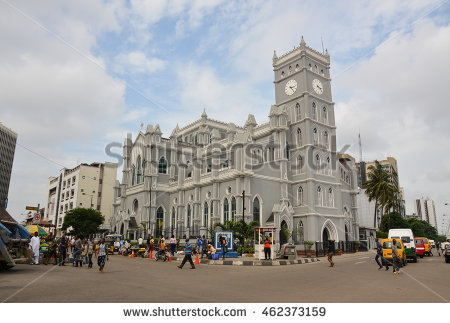
The Redeemed Christian Church of God’s international headquarters in Ogun state has been transformed from a mere megachurch to an entire neighbourhood, with departments anticipating its members’ every practical as well as spiritual need. A 25-megawatt power plant with gas piped in from the Nigerian capital serves the 5,000 private homes on site, 500 of them built by the church’s construction company. New housing estates are springing up every few months where thick palm forests grew just a few years ago.

To most people, this story is probably interesting because of what it says about Nigeria and religion.

But since I’m a wonky libertarian, what grabbed my attention was the fact that the church – for all intents and purposes – was building an anarcho-capitalist society.

Education is provided, from creche to university level. The Redemption Camp health centre has an emergency unit and a maternity ward. …“If you wait for the government, it won’t get done,” says Olubiyi. So the camp relies on the government for very little – it builds its own roads, collects its own rubbish, and organises its own sewerage systems. And being well out of Lagos, like the other megachurches’ camps, means that it has little to do with municipal authorities. …according to the head of the power plant, the government sends the technicians running its own stations to learn from them. …the camp’s security is mostly provided by its small army of private guards in blue uniforms.

To be sure, it’s not a purely anarcho-capitalist society. The Nigerian government still has ultimate power to enforce laws.

But from a practical, day-to-day perspective, the church has set up a private city governed by private contract and voluntary cooperation. Sort of a Nigerian version of Galt’s Gulch.

And it’s definitely worth pointing out that it is far more successful than traditional Nigerian cities (and it sounds like it works better than many American cities!).


Daniel J. Mitchell is a Senior Fellow at the Cato Institute who specializes in fiscal policy, particularly tax reform, international tax competition, and the economic burden of government spending.

Republished from International Liberty.

Read more

There’s a Hole in the Middle of Doughnut Economics

By Steven Horwitz 

The last 30 years have seen the demise of the Soviet Union and its administrative-command economy as well as a revolution in technology and trade that has reduced the transaction costs of using markets.

Many governments around the world have recognized the reality of the power of markets, liberalizing international trade and de-nationalizing production to benefit from the power of domestic competition. The Scandinavian countries have understood that even supporting a generous welfare state requires domestic economic growth, which has led them to cut business regulation and taxation in ways that have given them freer markets than in the US.

The result of all of these events has been an unprecedented reduction in human poverty. The number of people living on less than $1.90 per day (the current standard for extreme poverty) fell from 1.9 billion people, or about 37 percent of the world’s population, to about 700 million (9.6 percent) between 1990 and 2015.

In other words, severe poverty fell almost 75 percent in a mere 25 years, thanks to the freeing of global markets, especially in China and India. No government policy in human history has even come close to what markets have done over that period.

The success of that basic economic insight, that markets improve human well-being, has generated immense cognitive dissonance among many progressives.

Instead of recognizing the ways in which markets have addressed one of the left’s major concerns (severe poverty around the world), progressives, most of whom are not formally trained in economics, continue to attack both economics as a discipline and economists’ belief in the power of markets to address the condition of the least well-off.

Enter the Doughnut

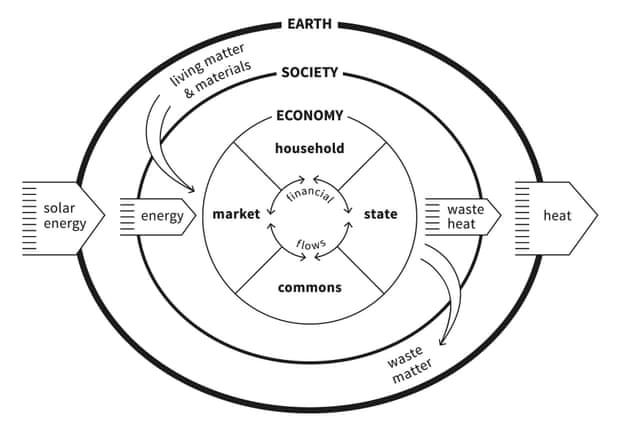
The latest entry in this endeavor is Kate Raworth’s Doughnut Economics. Raworth’s indictments of the discipline are a familiar list: homo economicus is unrealistic, economics doesn’t predict crises, it cannot account for the use of natural resources and the damage economic growth does to them, and it equates economic growth with “human well-being.”

Her contribution is a new visual model of the economy that sees it embedded in the center, with the state, the household, and the commons, as a series of concentric circles (like a doughnut) including “society” and the earth.

The idea is that we need to live “within the doughnut.” That is, economic activity should not harm the social or ecological relationships that provide the necessary context for that economic activity.

Unsurprisingly, the political wish list that her new model produces is pretty much the same list that progressives have wanted for the last century or more. In George Monbiot’s summary:

Wealth arising from the gifts of nature would be widely shared. Money, markets, taxation and public investment would be designed to conserve and regenerate resources rather than squander them. State-owned banks would invest in projects that transform our relationship with the living world, such as zero-carbon public transport and community energy schemes. New metrics would measure genuine prosperity, rather than the speed with which we degrade our long-term prospects.

With this new model, he and Raworth believe, all of these are actually possible in ways they haven’t been before.

Food for Growth

Unfortunately, Raworth’s new model does nothing to improve the likelihood that such measures will address the problems she identifies, and often misdiagnoses.

Her unwillingness to confront the question of whether real world actors, especially politicians, have sufficient information and the proper incentives to behave the way her theory says they should makes her doughnut economy model intellectually unappetizing.

Like so many critics of economics, Raworth misunderstands the discipline’s concern with economic growth. Growth is not desired for its own sake, but precisely because there is both theory and evidence to demonstrate that it is a necessary, but not sufficient, condition for reducing poverty and ecological damage, not to mention increasing the level of education, health, and longevity of the population, especially for women. Market-driven growth has turned women from baby machines, effectively owned by their husbands, into educated, full participants in the modern economy.

You can’t eat GDP, but economic growth is what enables us to feed, clothe, and shelter each other better and better. Economic growth makes it possible for all of humanity to expand our capabilities so that we can live healthy, comfortable, meaningful lives.

Canards Galore

Raworth also mischaracterizes the legitimate problems that she identifies. For example, the claim that markets produced the financial crisis and Great Recession. That canard has been refuted endlessly by various economists.

At the very least, people who make that argument have to explain how a housing boom produced by the combination of government central banks, government-enforced housing policies, and government-sponsored enterprises like Fannie Mae and Freddie Mac in the US, was somehow caused by “free markets.” The claim that markets are responsible is made as if it were obviously true, despite legitimate counter-arguments.

The claim that markets have destroyed the environment is subject to a similar response. Aside from the fact that, by many measures, the environment is faring better than it was a generation or two ago, Raworth’s claim ignores the environmental damage done by the same sort of state-directed economies that she wants to expand. The role of economic growth and the power of property rights to provide the means and institutional structure to encourage better management of resources is a better story.

The more fundamental problem with Raworth’s argument is that aggregate models such as her doughnut fail to account for the most fundamental question of political economy: how well do social, political, and economic institutions provide people with the knowledge and incentives they require to know when they have made mistakes and guide them about how to correct those mistakes?

Her model is at such a high level of aggregation and abstraction that there is no room for asking how and why real flesh-and-blood people act and make choices.

In that way, it is no improvement on the circular flow model and the various other aggregative macroeconomic models that, as she rightly points out, fail to explain the world. It’s odd that someone would criticize modern economics for a misguided model of human behavior and then introduce a model in which there appears to be nothing that resembles a human actor.

Imperfect Knowledge

In reality, the question facing all political economy is how to help individuals with limited and imperfect knowledge discover and correct their errors so that economic and social coordination is possible. We see such coordination all about us thanks to the market.

After all, Paris does get fed, and global poverty continues to fall. It is the price and profit signals of the market that serve, in the words of Ludwig von Mises, as “aids to the mind” in making possible such coordination and the riches it brings to all.

What Raworth and others like her also overlook is whether the political actors are able or willing to produce the outcomes they prescribe on their blackboards and computers. Even if it were theoretically desirable to have state-owned banks determine the direction of investment (which is hardly a new idea, as it can be found in Keynes among others), the real question is whether we can imagine a political process actually producing that outcome.

That is, would real, human actors within the institutional context of politics have the right incentives and information to produce the outcome that theorists like Raworth say they should?

For over 50 years, economists have deployed the set of ideas known as “public choice theory” to analyze the group decision making under political and other institutions. The results clearly indicate that there is no a priori reason to think that politics will produce the ideal outcomes that economists wish for. In fact, there are many reasons to think political institutions are unable to provide the information and incentives to do so.

This is why Keynesianism failed. The theory said politicians should run surpluses in the good times and deficits in the bad times. Doing so was not compatible with the incentives facing politicians who prefer to spend more and tax less in order to stay in office. The result has been decades of deficits.

Good intentions are not enough, nor are aggregate models that do not account for how the information and incentives produced by the institutional environment will enable people to turn those good intentions into good results.

That people like Raworth simply assume that politicians will do what theorists think best, regardless of whether political actors have the incentives and information to do so, means there is a giant hole in the center of their intellectual doughnut. And like real doughnuts, models like Raworth’s might look wonderful and delicious, but they end up containing very little in the way of intellectual nutrition.

Steven Horwitz is the Schnatter Distinguished Professor of Free Enterprise in the Department of Economics at Ball State University and a Distinguished Fellow at the Foundation for Economic Education (FEE).

Republished from FEE.org

Read more

Adeleke David: On Free Market and Equality

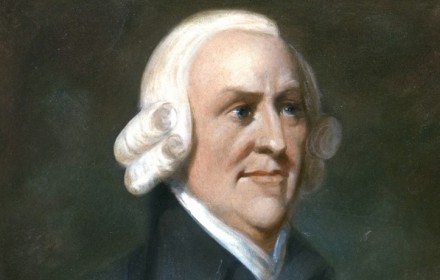
The following was one of the top essay entries in our 2017 Adam Smith Challenge on the topic “How Does Free Market Promote Equality According to Adam Smith?” 

In simple terms, free market is a market economy which is operates without undue and active interference by the government. Various authors have given various opinions on the principles of free market but the most detailed explanation was given by Adam Smith, who specialized in the field of economics.

His propositions on the principles of free-market can be traced to one of his books written in 1776 titled ‘The Wealth of Nations’. Instead of unnecessary interference by the government, Adam suggested ideas and set down various principles which according to him are guidelines to guarantee the success of a free market economy in achieving objectives such as the promotion of equal opportunities. Despite restricting government interference, he maintained that they can provide help in certain aspects in relation to performing normal function as the government such as the banking regulation.

How does free market promote equal opportunities?

One role the government is permitted to perform is to ensure everyone who is a consumer of public good or service should enjoy equal consumer satisfaction without the enjoyment of one causing deprivation of satisfaction for another. Therefore the free market economy advocates for selflessness, equality and fairness in the market. It can therefore promote equal opportunities by following the principles laid down by Adam Smith;

The Principle of Division of Labour: This provides equal chance for labourers to put their various professions into practice towards a particular objective and earn a living therefore ensuring a balance in the society. Sometimes it has to do with the use of invented machineries to carry out a job required. This means the opportunity is also extended to the inventors and not just the labourers physically at work.

The Principle of Trade by Barter: This simply involves the exchange of goods or services between people to ensure all parties acquire equal amount of satisfaction based on the wants and needs of each person. It also provides an atmosphere to explore the skills of one another.

The Principle of payment for government services based on ability: This can be in form of imposition and payment of tax to ensure the provision of good roads and other infrastructure. Good roads would benefit the members of the society generally and serve as a means of transporting goods and rendering services by traders. This therefore ensures equal opportunities for all traders in the market.

The principle of payment for government services based on utility: Here, the government charge based on the usage by consumers. It simply means the amount paid by consumers is directly proportional to the benefit enjoyed. This ensures equality and fairness in the society.

Free market should be adopted by various countries as it promotes the economy of a country if the guidelines of Adam Smith are followed. Taking Chile as an example, free market economy indeed promotes equal opportunities.

Read more